
News
The journal articles by UMRAM researchers published in October 2026.
- Understanding Older Adults’ And Caretakers’ Attitudes Toward Social Robots Using Natural Language Processing and Thematic Analysis, International Journal of Social Robotics. Authors: Begüm Çonka, Burcu Aysen Urgen, Yasemin Afacan
- A recurrent neuronal model for the effect of predictions on sensory processes, Scientific Reports. Authors: Buse Merve Ürgen, Hilal İrem Baştürk, Hüseyin Boyacı
The following hygiene procedures have been prepared for the safety of examiners, human participants and patients, our animal friends, and everyone working in UMRAM. Everyone MUST follow these rules strictly. Examiners, who…

Cognitive Computational Neuroscience Lab (Ürgen Lab) students Hüseyin Orkun Elmas and Sena Er were awarded a TÜBİTAK BIDEB scholarship. Congratulations! For more information ; https://tubitak.gov.tr/tr/duyuru/bideb-egitim-burs-programlari-2020-yili-2-donem-basvuru-sonuclari-aciklandi

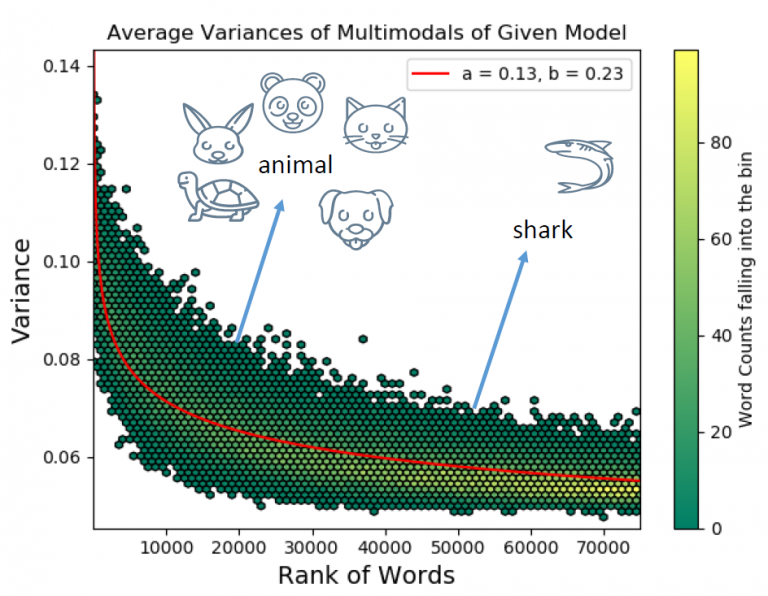
Zipfian regularities are important empirical laws in computational linguistics and natural language processing as well as several other areas of science. Zipf’s law of meaning distribution, one of the most important Zipfian…

Discrete signal scaling is a basic operation of central importance that poses several challenges, which are usually addressed as an interpolation problem. Our approach, which does not involve interpolation in the conventional…
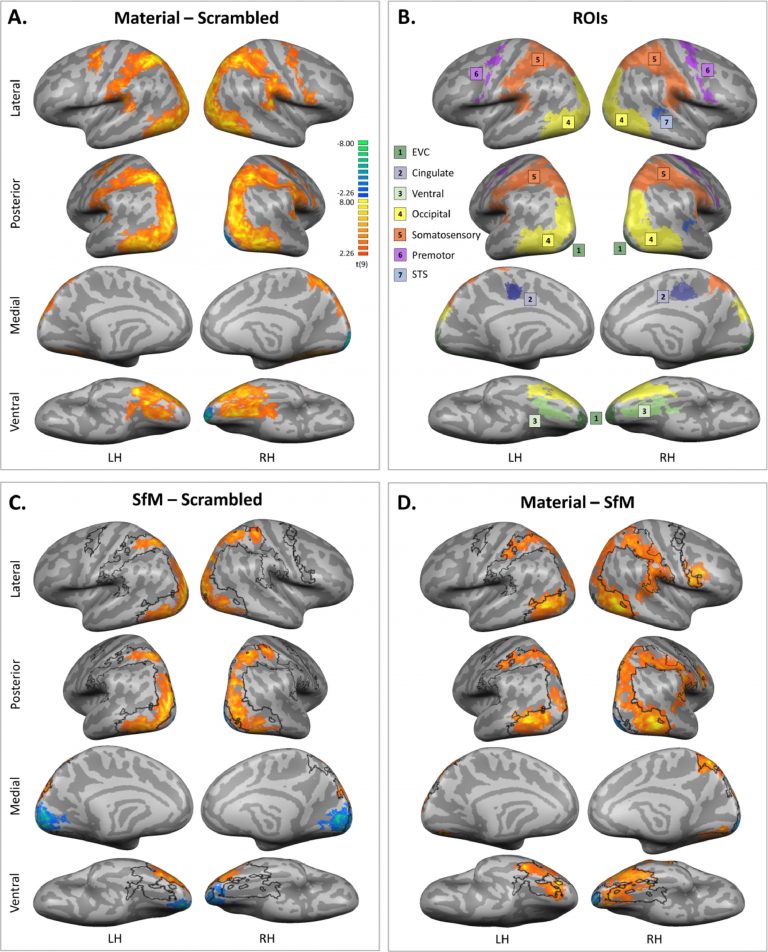
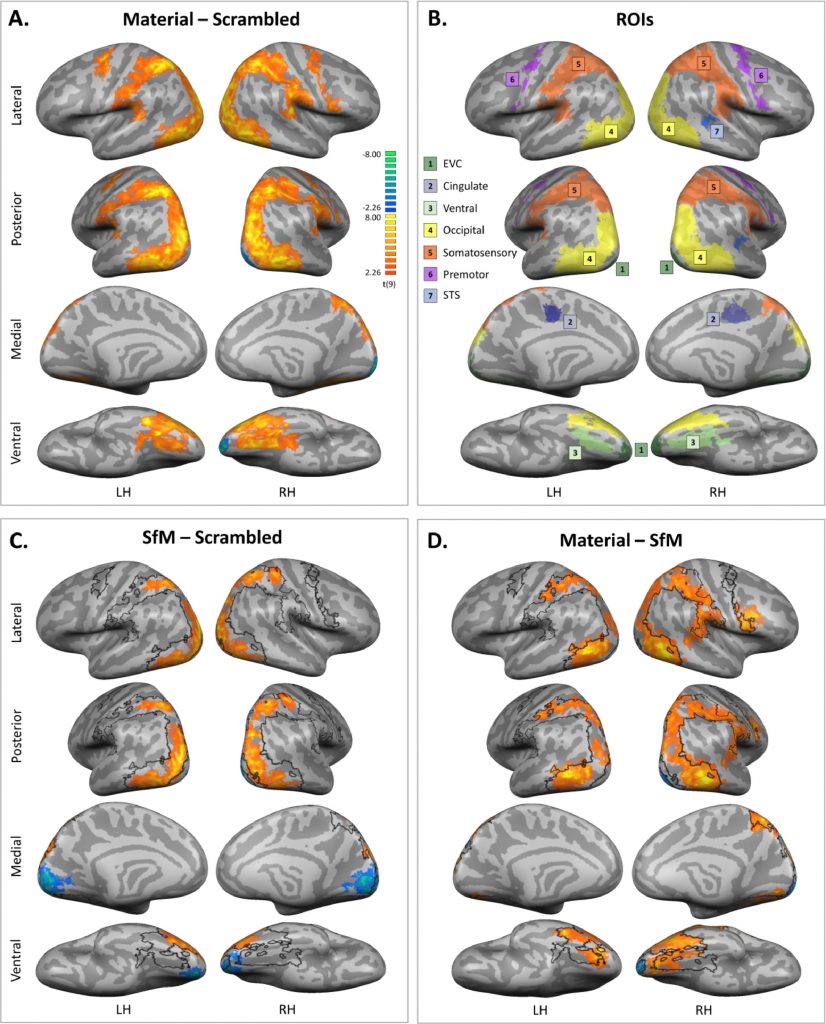
Using dynamic dot displays, Schimid et al. show that a large network of brain regions respond to material motion. The dynamic dot displays are similar to those in biological motion studies, and…
Abstract
There is growing research interest in the neural mechanisms underlying the recognition of material categories and properties. This research field, however, is relatively more recent and limited compared to investigations of the neural mechanisms underlying object and scene category recognition. Motion is particularly important for the perception of non-rigid materials, but the neural basis of non-rigid material motion remains unexplored. Using fMRI, we investigated which brain regions respond preferentially to material motion versus other types of motion. We introduce a new database of stimuli – dynamic dot materials – that are animations of moving dots that induce vivid percepts of various materials in motion, e.g. flapping cloth, liquid waves, wobbling jelly. Control stimuli were scrambled versions of these same animations and rigid three-dimensional rotating dots. Results showed that isolating material motion properties with dynamic dots (in contrast with other kinds of motion) activates a network of cortical regions in both ventral and dorsal visual pathways, including areas normally associated with the processing of surface properties and shape, and extending to somatosensory and premotor cortices. We suggest that such a widespread preference for material motion is due to strong associations between stimulus properties. For example viewing dots moving in a specific pattern not only elicits percepts of material motion; one perceives a flexible, non-rigid shape, identifies the object as a cloth flapping in the wind, infers the object’s weight under gravity, and anticipates how it would feel to reach out and touch the material. These results are a first important step in mapping out the cortical architecture and dynamics in material-related motion processing.
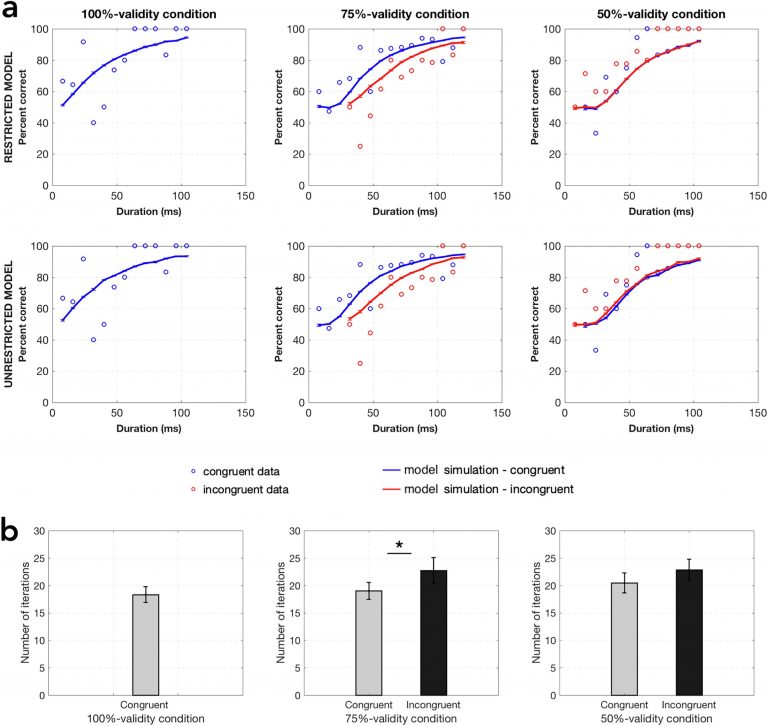
Prior knowledge and expectations play a substantial role in recognition and decision-making processes by governing the interpretation of the sensory stimulus and allowing us to make fast and accurate decisions. Whether and…
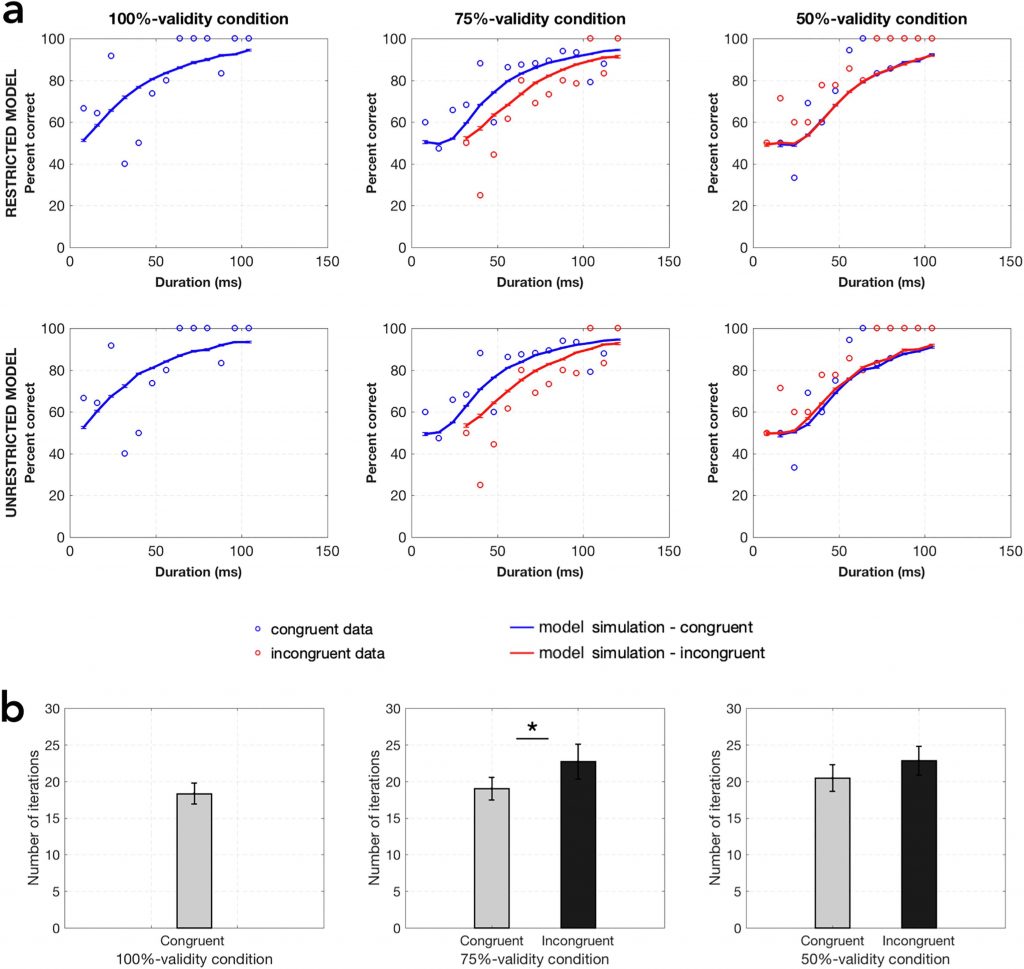
Abstract
Expectations strongly affect and shape our perceptual decision-making processes. Specifically, valid expectations speed up perceptual decisions, and determine what we see in a noisy stimulus. Despite the well-established effects of expectations on decision-making, whether and how they affect low-level sensory processes remain elusive. To address this problem, we investigated the effect of expectation on temporal thresholds in an individuation task (detection of the position of an intact image, a house or face). We found that compared to a neutral baseline, thresholds increase when the intact images are of the unexpected category, but remain unchanged when they are of the expected category. Using a recursive Bayesian model with dynamic priors we show that delay in sensory processes is the result of further processing, consequently longer time, required in case of violated expectations. Expectations, however, do not alter internal parameters of the system. These results reveal that sensory processes are delayed when expectations are not met, and a simple parsimonious computational model can successfully explain this effect.

One of our former PhD student Koray Ertan, has received 2020 Serhat Ozyar Young Scientist Award. ''Design of Z-Gradient Array and Applications in Magnetic Resonance Imaging" Koray Ertan completed his continuing doctoral…

Emine Ülkü Sarıtaş, faculty member at UMRAM, has received 2020 IEEE Turkey Research Incentive Award. Following its mission to encourage and support scientists, IEEE Turkey has launched an annual awards program in…
Parlar foundation gives Honorary, Science, Service, Research and Technology Incentive Awards every year in order to evaluate the research studies and services carried out in science and industry and to encourage the…

UMRAM faculty member Dr. Hulusi Kafalıgönül has received this year’s Outstanding Young Scientist Award from the Turkish Academy of Sciences (TÜBA). Dr. Kafalıgönül has been recognized for his work in the field…


The 18th National Neuroscience Congress (Ulusal Sinirbilim Kongresi) was hosted by Bilkent University between 6-9 November 2020. The congress was held virtually on Zoom due to the ongoing pandemic. The scientific program…


Dr. Huseyin Boyaci has been promoted to Professor rank. Dr. Boyaci is currently the vice-director of the National Magnetic Resonance Research Center (UMRAM). His primary affiliation is with the Department of Psychology…
